Wednesday, 7 November 2012
One Space Time Foam
Just fascinating, I wish i could test it!
http://www.hangarbicocca.org/exhibitions/On-Space-Time-Foam-Tomas-Saraceno/

Monday, 5 November 2012
Matthias Oostrik activates the observer

Sunday, 4 November 2012
Marina Abramovic
Hello everyone,
Here a link of a 1,5h video about Marina Abramovic and her work. She is the artist Matthias Oostrik is working with now.
Enjoy watching.
http://cultuurgids.avro.nl/front/detailcloseup.html?item=8276184
Here a link of a 1,5h video about Marina Abramovic and her work. She is the artist Matthias Oostrik is working with now.
Enjoy watching.
http://cultuurgids.avro.nl/front/detailcloseup.html?item=8276184
Wednesday, 31 October 2012
Installation at Kortrijk Biennale
He doenst made-up the movements. The installation translate what the sensors in the water intercept.
Maybe there are more examples at his website: http://www.dwbowen.com/index.html
Thursday, 18 October 2012
Installation by Susie Lee
Lee is interested in the playfulness of girls and the elusiveness of childhood.
Tuesday, 9 October 2012
Visualizing a walk
same artist as the sea-level project, Rhonda Weppler, also visualized her walks by collecting items she found on the way.


Visualizing Sea Level Rise
Artists Rhonda Weppler and Trevor Mahovsky visualized the projected changes in sea levels over the coming years.


Wednesday, 3 October 2012
Instalation by Onishi Yasuaki
Very interesting instalation by Onishi Yasuaki. He sais he's interested in revealing things that are invisible. I suggest to watch the video of how it was made.
http://www.archdaily.com/232527/reverse-of-volume-rg-installation-onishi-yasuaki/
http://www.archdaily.com/232527/reverse-of-volume-rg-installation-onishi-yasuaki/
Thursday, 27 September 2012
Hey everybody,
here an installation that frontates the visitor with the nature in a very directly and also poetic way.
It just shows what`s around you all the time. Simple but strong.
http://www.studioweave.com/projects/kedleston-hall/
here an installation that frontates the visitor with the nature in a very directly and also poetic way.
It just shows what`s around you all the time. Simple but strong.
http://www.studioweave.com/projects/kedleston-hall/
Wednesday, 26 September 2012
my photos of james turrell work
As i have told you in class we went last year to the biennale in Venice and i have been in one of James turrell work here are some pictures ;)


this is all on work!


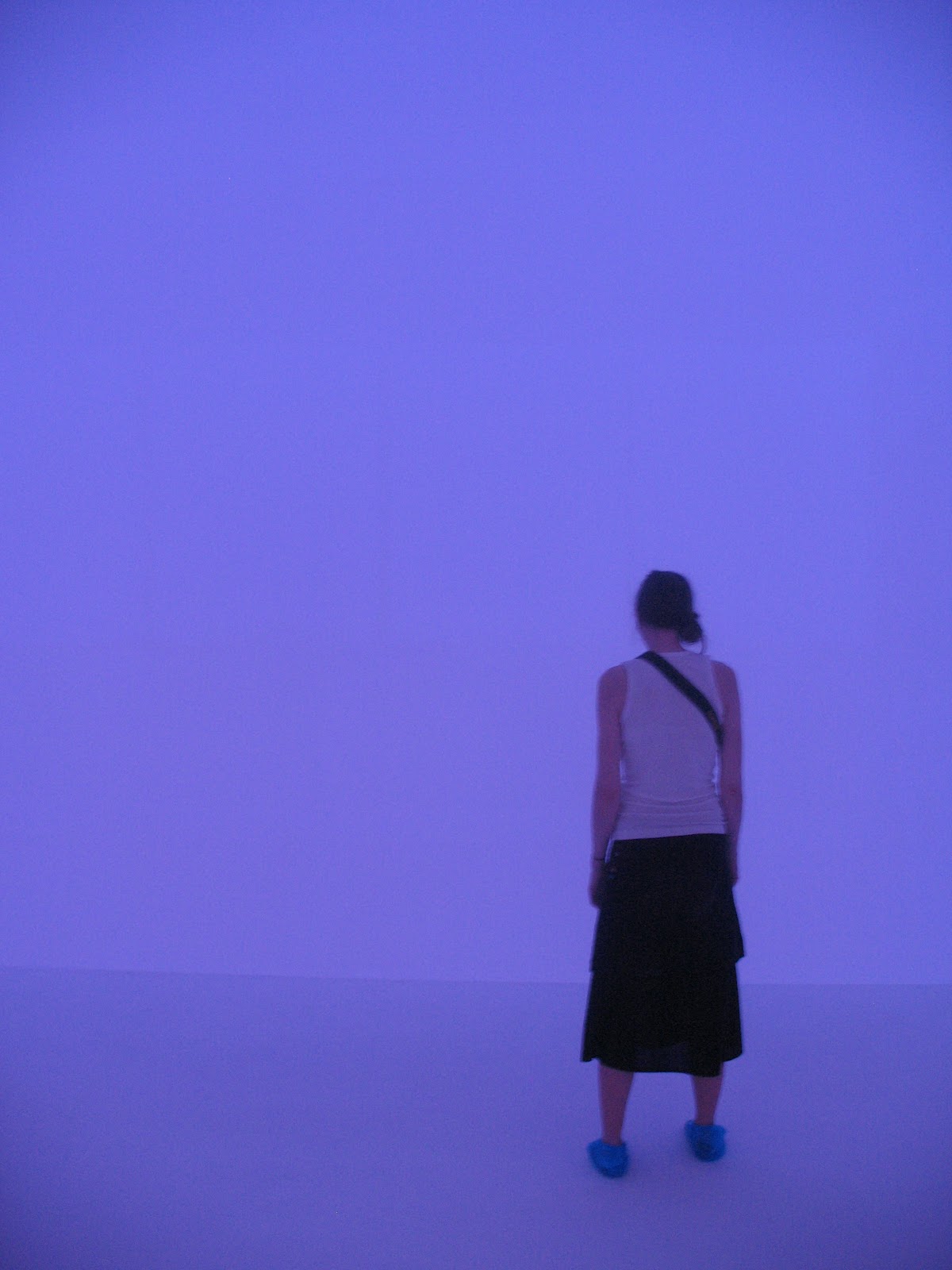
this is all on work!
Exampels of inforamtion
Hello everyone
Here are my examples that i didn't had tome to show ;)
The british pavilion on the shangahi world expo in 2010


Anish kapor


Christian Boltanski, "The missing House", 1990 on Grosshamburger strasse, Berlin


Here are my examples that i didn't had tome to show ;)
The british pavilion on the shangahi world expo in 2010


Anish kapor


Christian Boltanski, "The missing House", 1990 on Grosshamburger strasse, Berlin


Infospace and Documentaries at 'CLose up'
Hello everybody, I still own you some examples of infospace. Last thursday we had some real good and clear examples, but all made by artists. And I was wondering, do we make infospaces ourselfs without being aware of it? And I came to this example:
 It gives us the information of how many people reached this summit, and from which country they are. And indeed it is a collection of loose flags, but together they are one subject.
My next example is from the artist Job Koelewijn. It is a sentence, but on the water made by sort of little fountains on the bodem of the 'river'. I had a doubt about this one, because somewhere it is information in 3D, but on the other side it are still words. What do you think?


My next example is from the artist Job Koelewijn. It is a sentence, but on the water made by sort of little fountains on the bodem of the 'river'. I had a doubt about this one, because somewhere it is information in 3D, but on the other side it are still words. What do you think?


In class I told you about a schoolproject. Three times a day I collected my shades in one particular round. The information these three rounds give me, I translateded it into a 3d object. But then on small scale. The information was how the sun turns and how that influence my shades. (Actually the photo's are too bad, that it isn't worth to put them on the blog)


Then at last, I would like you to see a documentary about Anish Kapoor. He explain his mirror works and why the color red is so important to him. I think his mirrorworks relates to our subject, because his aim is to informate people about that real life isn't what it looks like. His mirrors show us more than we see.
By the way, this program : 'Close-up' is very interesting. Every tuesdaynight (22.30u? at avro, NED2) an other subject : architecture, film, schilderkunst, beeldhouwkunst, photografie, design, and fashion.
Monday, 24 September 2012
D-Tower in Doetinchem
Hi all,
I also wanted to show this installation by artist Q. Serafijn and architect Lars Spuybroek, and it is a 'mood' tower that 'maps' the emotions of the inhabitants of the city of Doetinchem. Every citizen of the town of Doetinchem can decide which colour approaches the mood of that day the best. The tower will show the mood of the city, the people can fill out a questionnaire where subjects like love, hate, happiness and fear are tackled. These emotions are then translated into a colour at the end of the day.
More information can be found on: http://www.d-toren.nl/site/

I also wanted to show this installation by artist Q. Serafijn and architect Lars Spuybroek, and it is a 'mood' tower that 'maps' the emotions of the inhabitants of the city of Doetinchem. Every citizen of the town of Doetinchem can decide which colour approaches the mood of that day the best. The tower will show the mood of the city, the people can fill out a questionnaire where subjects like love, hate, happiness and fear are tackled. These emotions are then translated into a colour at the end of the day.
More information can be found on: http://www.d-toren.nl/site/

Sunday, 23 September 2012
Why attractive things work better
Here's a diagram about what I was trying to explain in the first class. You can read about it in "Emotional Design", chapture: "Attractive things work better".
 |
Affordances
An affordance is the design aspect of an object which suggest how the object should be used; a visual clue to its function and use. If you think you've found a good example, post it!
 |
| Mercedes Benz Seat adjustment control |
Infoscapes Brief
course abstract:
(mind the blue part at the end, it is missing in your earlier digital version) |
| Inuit "TomTom" |
We live in the age of information.
Three quarters of our waking time is spent receiving information, the majority of which is electronic. Every day we are literally being overwhelmed by information. Does it bring us knowledge? Too much information is a lot like no information. Does it make our lives more meaningful or is it depriving us from elementary experiences of the “here and now”? In this class we will explore various ways of perceiving and conveying information. Traditionally, and still, information is exclosed through visual and auditive tools, but can information also engage our other senses? Can we translate information into a spatial, sensory experience? What sort of information could that be?
assignments:
PART 1: RESEARCH BY DESIGN Students are given very short case-study assignments to explore various ways to interpret and translate information from one sensorial experience to another. Think of: Synesthesia Examples: The sound message (bracelet); sound ---> visual ----> tactile Mondriaan’s Victory Boogiewoogie ; sound--->visual
PART 2a: DESIGN Design an “urban intervention” wich reveals (phenomenological) “information”. Turn an implicit phenomenon into an explicit experience. Architecture, technique, the public audience play an important role in the installation.
PART 2b: REALISATION Make your installation in a way that it can be experienced convincingly and tested. If neccessary, the design is further improved according to the test results. Be inventive: improvise or simulate to reach the desired effect.
Presentation
Case study presentation is internal. Interim design presentation to professionals in the field. Final presentation is a departmental review.
Examination
Students are expected to attend each studio at the designated time. Students, who for some legitimate reason cannot attend class, should inform the course instructor in advance of the times they will be absent. The final mark will be decided on the grounds of:
-case study presentation
-determining a design direction
-individual and group participation
-quality of presented work
-determining a design direction
-individual and group participation
-quality of presented work
-overall design quality
-degree of presence
Aims
-To introduce students to installation design, interactive design and information design
Students will be able to:
- use discussion and reading as a strategic tool for new insights into design
- translate abstract or unnoticed information
- conceive new and attractive ways to re-interpret natural phenomena and to examine it through [physics] experiments.
- transform experience and observation into visual and physical prototypes.
- execute their design to the extend that it can be tested.
-evaluate their own design and that of others in a way that it contributes to the improvement of the design.
INFOSCAPES
Dear All,
Welcome to the blog of INFOSCAPES. Here we can exchange information related to the class. Please use it, post ideas (you have been invited by email to join as a co-author, if not: let me know), react on eachother and get inspired. Looking forward to your creative ideas!
 |
| Ryoji Ikeda |
Wednesday, 14 December 2011
Tuesday, 13 December 2011
Final presentation: print or slides?
So, for the final presentation you are supposed to prepare a slideshow. You are also supposed to present prints of technical drawings. You can choose if you want to add them to your slideshow as well, but they have to be there physically. Some of you have only shown very rough and sketchy work so far. I really expect careful and precize work as your final result so... don't be lazy!
Inflatables
For Gwen: I found these links and refs for you:
Blow up, a book about inflatable Art, which also features here.
Blow up, a book about inflatable Art, which also features here.
 |
In the book: Deflate-ables by 010 publishers  |
Subscribe to:
Posts (Atom)